











Article
10 Best Managed Office Providers in India 2026: Pricing

TL;DR
A managed office is a private, branded workspace where a third-party provider handles fit-out, furniture, IT, maintenance, and daily operations under one contract. India’s flexible office stock is expected to cross 100 million sq ft by 2026, and enterprises now account for roughly 70% of flex seat demand. The right provider depends on team size, city, go-live timeline, and contract terms, not brand popularity. For teams comparing options across multiple providers and cities without brokerage, CoSqrd offers zero-brokerage advisory and guided shortlisting from discovery through move-in.
What Is a Managed Office?
A managed office is a private or semi-private workspace designed, furnished, and operated by a third-party provider. The client gets dedicated space with custom layouts, branding options, IT setup, access control, facility management, housekeeping, pantry, meeting rooms, and operational support bundled into a single agreement.
It sits between coworking and a traditional lease. Coworking gives you a desk in a shared room. A traditional lease gives you an empty shell and the burden of building everything yourself. A managed office gives you the privacy and control of a lease with the speed and operational simplicity of coworking.
Managed Office vs Coworking vs Traditional Lease
| Feature | Coworking hot desk | Private cabin | Managed office | Traditional lease |
|---|---|---|---|---|
| Best for | Freelancers, 1-5 people | 2-20 people | 20-1,000+ seats | Stable long-term teams |
| Control over space | Low | Medium | High | Very high |
| Setup burden | None | Low | Low to medium | Very high |
| Typical commitment | Daily/monthly | Monthly/quarterly | 6-36 months | 3-9 years |
| Main risk | Noise, no privacy | Limited customization | Contract terms, operator delivery | CapEx, delays, inflexibility |
For teams under 10-15 people, a private cabin in a coworking space often makes more sense economically. Managed offices become the stronger option once team size crosses 20-50 seats and privacy, branding, or facility accountability starts to matter.
Quick Comparison: Best Managed Office Providers in India
| Provider | Best for | Pricing | Key differentiator | Strongest cities | Main tradeoff |
|---|---|---|---|---|---|
| CoSqrd | Broker-free comparison across providers | Quote-based, zero brokerage | Marketplace + guided shortlisting + tours | Multi-city India | Limited public case studies |
| Smartworks | 300+ seat enterprise campuses | Quote-based | Large managed campuses, ~88% enterprise revenue | Bengaluru, Delhi NCR, Hyderabad, Pune, Mumbai | Not for small teams |
| Table Space | Premium enterprise/GCC offices | Quote-based, premium | Bespoke builds for MNCs | GCCs, Grade A assets | Usually not first choice for small teams |
| WeWork India | Premium design and employee experience | ₹20k-22k/seat indicative | Brand, design consistency | Bengaluru, Mumbai, Delhi NCR, Hyderabad | Premium pricing |
| Awfis | Wide India coverage, cost-conscious teams | ₹7.5k-12k coworking range | 208 centres, 18 cities | Pan-India | Quality can vary by centre |
| IndiQube | Tech-first scaling teams | Quote-based | Tech-enabled workspaces, 86.57% occupancy | Bengaluru, Hyderabad, Pune, Chennai | Less premium brand cachet |
| COWRKS | Premium Brookfield-backed enterprise | Quote-based | Enterprise Plus, prime assets | Bengaluru, Mumbai, NCR | Premium, may be overbuilt for small teams |
| Simpliwork | Outsourced enterprise offices | Quote-based | Built-to-suit, 360-degree facility management | Bengaluru, Mumbai/Pune | Not a broad coworking option |
| Incuspaze | Practical multi-city managed offices | Quote-based | Balanced managed office + coworking | 18+ cities | Experience varies by location |
| iSprout | GCC-ready offices, South India focus | Quote-based | 24x7, enterprise-grade, regional depth | Hyderabad, Bengaluru, Chennai, Pune | Smaller footprint nationally |
How to Choose a Managed Office Provider: The SCALE Framework
Most articles list providers and stop. That is not enough. The provider that looks best on a website may deliver poorly in the specific micro-market and seat count a team needs. Use this five-part framework before shortlisting.
S: Seat Plan and Space Density
Ask whether the office is sized for the team today or the team 12 months from now. Check seat count, density (sq ft per seat), meeting room ratio, phone booths, breakout areas, and visitor or reception needs. A managed office quoted for 50 seats at tight density with two shared meeting rooms will feel very different from one with the same seat count at comfortable spacing and four dedicated rooms.
C: Commercial Hygiene
Are all cost drivers visible before signing? Check whether pricing is per seat or per sq ft, the deposit amount, lock-in period, annual escalation rate, GST treatment, meeting room overage charges, after-hours HVAC costs, true-down rights (can you reduce seats mid-term?), expansion rights, and exit fees. Practitioners on Reddit specifically advise managed office buyers to check deposit, lock-in, notice period, annual escalations, and how price changes if seat count shifts mid-term.
A: Access and Commute
A premium brand in the wrong micro-market is a bad deal. Check metro or rail connectivity, parking, last-mile travel, talent cluster proximity, client proximity, and safety after hours. The difference between BKC and Andheri, or between Koramangala and Whitefield, can change commute times by 30-45 minutes each way.
L: Launch Readiness
Can the provider actually deliver on the promised date? Check fit-out stage, building occupancy certificate and fire compliance, IT go-live date, access cards, furniture, power backup, ISP redundancy, pantry readiness, meeting room AV setup, and who owns the snag list.
E: Enterprise Operations
Who is accountable after move-in? Check the single point of contact, SLA structure, housekeeping frequency, security, helpdesk, visitor management, IT support scope, business continuity plan, and expansion or relocation support.
10 Best Managed Office Providers in India
1. CoSqrd
Best for: Broker-free managed office discovery and guided comparison across Indian cities.
Choose CoSqrd when the goal is not to start with one operator’s inventory. It works as a comparison and execution layer: discovery, shortlisting, tours, commercial term review, and move-in coordination across multiple providers and cities.
Pricing: Managed office engagements are quote-based after discovery. CoSqrd provides zero-brokerage advisory and guided tours at no cost to the tenant. Virtual office plans start separately from ₹1,200/month for business registration, ₹1,600/month for GST registration, and ₹2,000/month for premium all-in-one (varies by city and operator).
Key features:
- India-first workspace marketplace covering 25+ cities
- Locality-level inventory across coworking, private offices, managed offices, virtual offices, and coliving
- Zero brokerage and best-price positioning
- Guided site visits and coordinated tours
- Commercial benchmarking and term-sheet support
- Enterprise and GCC programs for multi-city footprints, hybrid layers, and BCP swing seats
- One point of contact from shortlisting through week-one readiness
Tradeoffs:
- No detailed public case studies available
- No formal free trial advertised
- Managed office pricing is not publicly listed
- Virtual office compliance depends on partner documentation (CA validation advised)
Why it matters: Operators show their own inventory. A marketplace helps compare across inventory. For teams evaluating options in HSR Layout, Koramangala, BKC, or Connaught Place simultaneously, this cross-provider view saves weeks.
2. Smartworks
Best for: Large enterprise campuses and 300+ seat requirements.
Pricing: Quote-based. Likely competitive at scale given the enterprise-heavy model.
Key features:
- 8.99 million sq ft across 50 centres in 15 cities (as of March 2025)
- 203,118 total capacity seats
- About 88% of revenue from enterprise clients, with more than 60% from customers with 300+ seats
- Average client tenure of approximately 50 months for 300+ seat clients
- Operational-centre occupancy of 83.12%
Source: Smartworks Annual Report FY2025
Tradeoffs:
- Not ideal for freelancers, solo founders, or teams under 50
- Large-format model may mean longer commitments
- Buyers should negotiate expansion and true-down terms carefully
Real-world signal: Smartworks’ July 2025 IPO was reportedly oversubscribed about 13.5x, signaling institutional confidence in the enterprise managed office model.
3. Table Space
Best for: Premium enterprise and GCC managed offices in Grade A assets.
Pricing: Quote-based. Premium positioning.
Key features:
- Portfolio expanded to 10.5 million sq ft by March 2025
- 75 centres across seven Indian cities
- Fully customized, bespoke managed offices for large corporates
- Google reportedly secured 550,000 sq ft from Table Space in Gurugram with expansion options
Source: Business Standard, Source: Times of India
Tradeoffs:
- Overkill for small teams or budget-first startups
- Public tenant reviews are sparse (enterprise sales happen through procurement)
- Verify delivery timeline and fit-out inclusions before signing
4. WeWork India
Best for: Premium design, brand consistency, and employee experience across major metros.
Pricing: Premium. GoFloaters estimates WeWork cabin desk pricing around ₹20,000-₹22,000/month, with a 10-seat space costing ₹2 lakh+ per month. Managed office pricing is quote-based.
Key features:
- 114,000 desks and 7.7 million sq ft of operating space across eight cities
- 68 operational centres as of June 2025
- Strong design and interiors
- Private offices, coworking, managed offices, hybrid products
- Largest operator by total revenue across FY23-FY25 according to CBRE
Source: Mint, Source: IPOCentral
Tradeoffs:
- Premium pricing, not always the best value for teams that only need functional space
- Global Trustpilot reviews show polarized sentiment (great spaces but inflexible contracts)
- Reddit IPO discussions flagged brand-license dependency, long fixed leases versus shorter client terms, and city concentration
One Trustpilot reviewer praised the ability to use well-appointed WeWork spaces across cities with low friction, while another complained about paying for time they could not use after relocating to a city without a WeWork location.
5. Awfis
Best for: Wide India coverage and cost-conscious flexibility for SMEs and multi-city teams.
Pricing: Managed office is quote-based. Awfis desk pricing in Chennai ranges around ₹7,500-₹12,000/month for coworking, with city-level variation.
Key features:
- 134,121 operational seats across 208 centres in 18 cities
- Record net revenues of ₹1,208 crore in FY2024-25 (42% YoY growth)
- ₹402 crore operational EBITDA
- Coworking, managed office, customized office solutions, meeting rooms, virtual offices
- Expanding into Tier 2 markets including Chandigarh
Source: Awfis Annual Report FY2025
Tradeoffs:
- Design and service quality can vary by location
- Not as premium as WeWork or Table Space in some micro-markets
- Need site-specific due diligence before committing
Real-world signal: A Reddit user in r/StartUpIndia said they had a “quite good experience” working in Awfis coworking, while another Bengaluru thread called Awfis expensive. Both are anecdotal but highlight that experience is location-specific.
6. IndiQube
Best for: Tech-first scaling teams and large flexible offices.
Pricing: Quote-based for managed offices. Generally more cost-conscious than premium operators.
Key features:
- 9.14 million sq ft AUM across 16 cities and 125 centres
- 801 clients, 169,395 seats under active stock
- 128,849 occupied seats at 86.57% occupancy (H1 FY26)
- Virtual offices, coworking, private cabins, enclosed offices, enterprise campuses
- Asset transformation, interiors, services, technology ecosystem
Source: IndiQube Investor Presentation H1 FY26
Tradeoffs:
- Less premium global brand cachet than WeWork
- Quality and fit may vary by city and building
- Test IT, meeting rooms, density, and support quality during the tour
7. COWRKS
Best for: Premium Brookfield-backed enterprise workspaces.
Pricing: Quote-based. Premium relative to local providers.
Key features:
- Managed workspace footprint expanded to over 1 million sq ft across major cities
- Enterprise Plus portfolio for enterprises and GCCs
- Prime city assets with strong property backing
- Cashfree Payments reportedly leased 80,000 sq ft from COWRKS in Bellandur, Bengaluru for a corporate headquarters
Source: Newsdrum/PTI, Source: PropNewsTime
Tradeoffs:
- Better fit for enterprise or premium teams than freelancers
- Public tenant reviews are limited
- Pricing may be less flexible than smaller operators
8. Simpliwork
Best for: Outsourced enterprise offices and built-to-suit managed workspaces.
Pricing: Quote-based. Project and office-specific rather than simple per-seat pricing.
Key features:
- Operational footprint of about 4.5 million sq ft, targeting 9-9.5 million sq ft over two years
- Built-to-suit offices for large enterprises
- 360-degree facility management
- Pan-India vendor network and tech-enabled operations
- Leased about 132,000 sq ft in Bengaluru for a fully managed, high-specification workspace
Source: Economic Times, Source: Business Standard
Tradeoffs:
- Not useful for freelancers or very small teams
- More enterprise and built-to-suit than “walk in tomorrow” coworking
- Scrutinize delivery timeline, snag ownership, and handover SLAs
9. Incuspaze
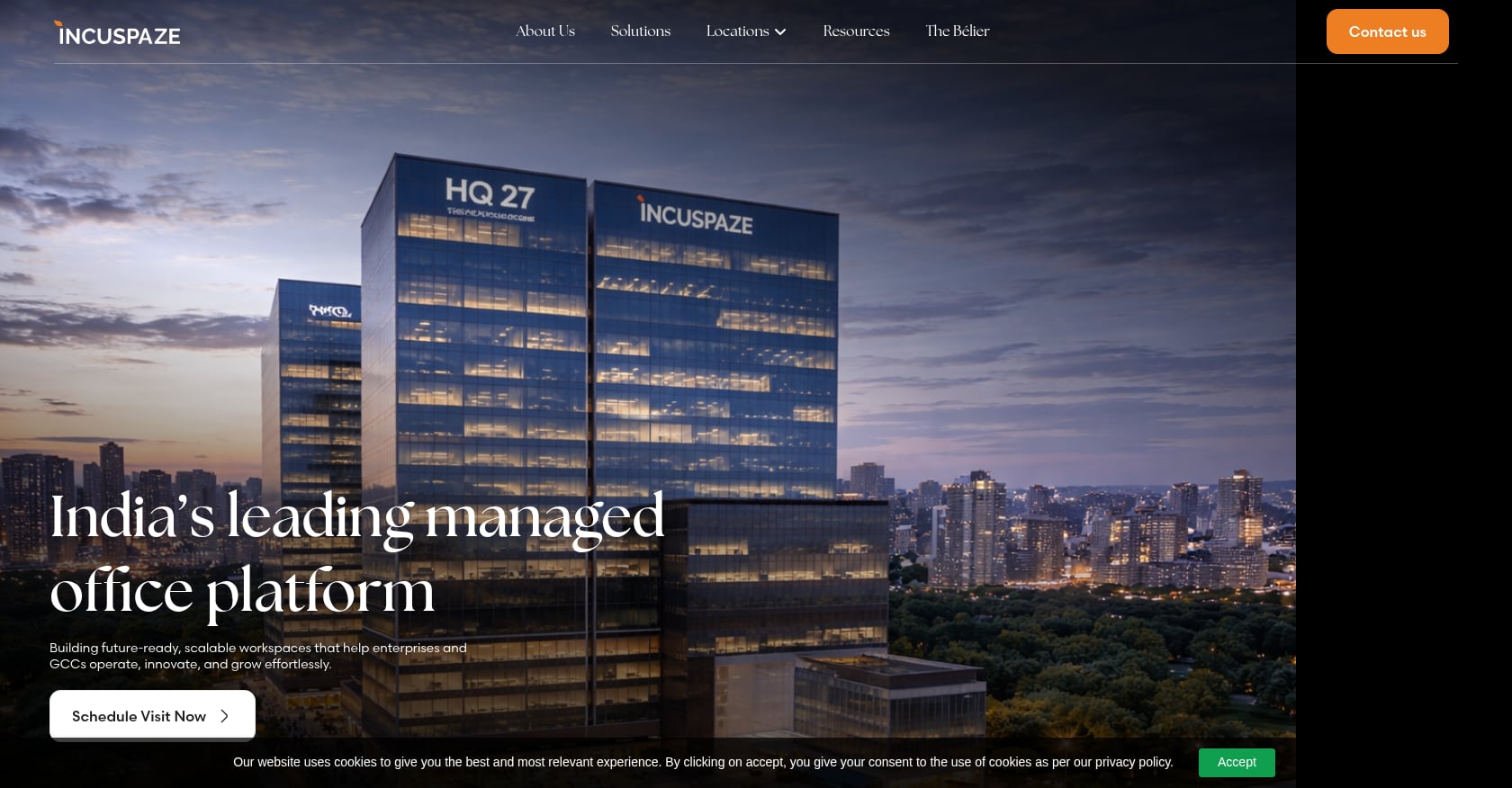
Best for: Practical multi-city managed office coverage including emerging markets.
Pricing: Quote-based. Likely more flexible than premium-only operators.
Key features:
- 4 million sq ft portfolio across 18 cities
- Added 2.01 million sq ft in 2024 across Noida, Mumbai, Jaipur, Pune, Chennai, Ahmedabad, Bengaluru, and Gurugram
- Managed offices, design and build, asset leasing, coworking
Tradeoffs:
- Not as premium as Table Space or WeWork in brand perception
- Centre quality likely varies by building
- Compare IT, furniture density, meeting-room ratio, and after-hours support on tour
10. iSprout
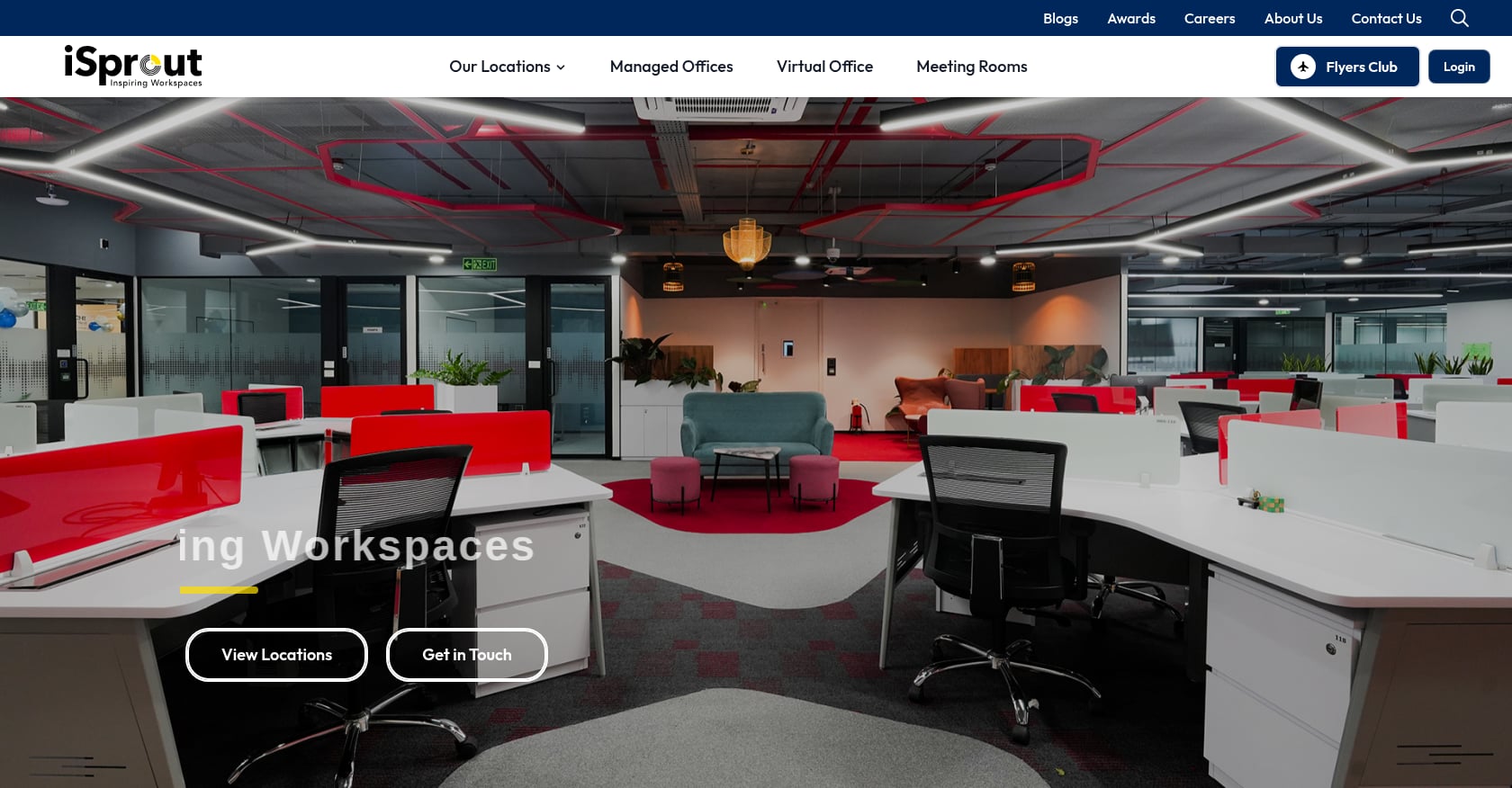
Best for: GCC-ready managed offices with strong Hyderabad and South India presence.
Pricing: Quote-based.
Key features:
- 28 centres and 39,000+ workstations across Hyderabad, Bengaluru, Chennai, Pune, Vijayawada, Vizag, Delhi NCR, Kolkata, and Ahmedabad
- Enterprise and GCC-ready workspace with 24x7 operations
- Security-first infrastructure
Tradeoffs:
- Smaller national footprint than Smartworks, WeWork, Awfis, or IndiQube
- More regional and enterprise-specific than a broad marketplace
- Needs city-by-city validation
Managed Office Pricing in India
Managed office pricing is rarely published transparently. It depends on city, micro-market, building grade, seat count, density, fit-out level, contract length, IT requirements, meeting room allocation, and a dozen other variables.
Indicative City-Level Ranges
These are directional benchmarks, not guaranteed rates. Always get 3-5 comparable live quotes.
| City | Indicative per-seat range (₹/month) |
|---|---|
| Bengaluru / Hyderabad | ₹9,000-16,000 |
| Mumbai | ₹12,000-22,000 |
| Delhi NCR | ₹10,000-18,000 |
| Pune / Chennai | ₹8,000-14,000 |
GoFloaters reports general coworking budgets starting around ₹6,000/seat/month, while WeWork cabin desks can run ₹20,000-22,000/month. CBRE’s flex-space digest shows managed-space ranges varying widely: ₹8,000-15,000 in Bengaluru, ₹9,000-25,000 in Mumbai, ₹11,000-27,000 in Delhi.
A Reddit user in r/StartUpIndia noted a 6-seater Mumbai coworking office costing about ₹1.2 lakh/month. That is ₹20,000 per seat for a small team, which shows that “managed/flex is cheaper” is not always true at small team sizes. For teams comparing managed office quotes with coworking pricing in specific localities, the math shifts depending on how many seats are needed and what is included.
Hidden Costs to Watch
Before signing any managed office agreement, verify these line items explicitly:
- Security deposit (often 3-6 months)
- Lock-in period and notice period
- Annual escalation (5-15% is common)
- GST and statutory charges
- Meeting room credits and overage rates
- After-hours HVAC and access charges
- Dedicated internet or leased line cost
- IT support scope
- Parking allocation and cost
- Signage and branding approvals
- Pantry and F&B charges
- Housekeeping frequency
- Access-card cost
- Seat expansion and true-down terms
- Restoration or exit charges
- SLA penalties (if any)
- Whether pricing is per workstation, chargeable seat, carpet area, leasable area, or super built-up area
What Buyers Learn Too Late
- A premium brand can still be wrong if the commute is bad.
- A cheap per-seat quote can become expensive after meeting room, parking, after-hours AC, IT, and GST.
- “Private office” is not the same as “managed office.” Confirm dedicated space, branding, and facility accountability.
- Seat count is not the only sizing metric. Meeting rooms and density matter as much.
- Long lock-ins weaken the main reason to choose flex in the first place.
- For teams under 10-15 people, private cabins or coworking may beat managed office economics.
- For teams above 50-100, managed office starts to win when privacy, branding, and operational control matter.
- For GCCs, the real value is not desks. It is launch speed, compliance, security, scalability, and one accountable operating partner.
A practitioner on LinkedIn framed it well: managed flex has become a structural operating model for GCCs, not a temporary solution, because it offers faster go-live, minimal upfront capital, lower deposit burden, single-point accountability, and demand-led scaling.
Best Managed Office Locations in India
Mumbai: BKC, Andheri, Lower Parel, Powai, Worli, Navi Mumbai. BKC is the premium enterprise hub. Andheri offers broader inventory at lower rates. Lower Parel suits corporate, media, and finance teams.
Bengaluru: HSR Layout, Koramangala, Indiranagar, Whitefield, Electronic City, ORR/Bellandur. Whitefield is a major IT corridor. Koramangala and Indiranagar attract startups.
Hyderabad: HITEC City, Madhapur, Gachibowli, Financial District, Kondapur. GCC demand is concentrated here.
Delhi NCR: Cyber City, Golf Course Road/Extension, Udyog Vihar, Noida Sector 62/63, Noida Expressway, Aerocity, Connaught Place.
Pune: Kharadi, Hinjewadi, Baner, Balewadi, Viman Nagar, Koregaon Park.
Chennai: Guindy, OMR, Perungudi, Taramani, Anna Nagar.
Kolkata: Salt Lake, New Town, Kasba.
Tier 2 growth: Cushman & Wakefield notes occupiers expanding to Chandigarh, Jaipur, Kochi, Trivandrum, Coimbatore, Visakhapatnam, and Bhubaneswar.
Managed Office Tour Checklist
During any site visit, check these 16 items. They are the difference between a good deal on paper and a bad office in practice.
- Is this space dedicated to your team or shared?
- What is the exact seat count and density (sq ft per workstation)?
- How many meeting rooms are dedicated vs shared?
- Is internet dedicated, shared, or redundant?
- What is included in the monthly fee and what is extra?
- What is the after-hours access and HVAC policy?
- Can the company brand the space (walls, signage, reception)?
- What is the parking allocation?
- What are the security and access-control rules?
- Who handles repairs and what is the escalation path?
- What is the current fit-out stage?
- What is the confirmed move-in date with penalties for delay?
- What happens if headcount changes mid-term?
- Is the building OC and fire compliance current?
- What is the pantry setup and F&B arrangement?
- What power backup exists and for how long?
One founder on Reddit gave a useful tip about meeting room charges: some managed offices include a certain number of meeting room hours per month, and anything beyond that is billed at ₹500-2,000 per hour. That overage cost adds up fast for sales-heavy or client-facing teams.
Contract Terms to Check Before Signing
These 20 clauses matter more than the headline per-seat rate.
- Lock-in period
- Notice period
- Security deposit
- Annual escalation
- GST and statutory charges
- Meeting room credits
- IT uptime SLA
- Dedicated bandwidth
- Access hours
- HVAC hours
- Parking
- Expansion rights
- True-down rights
- Fit-out handover date
- Operator SLA penalties
- Exit and restoration charges
- Branding and signage approvals
- Substitution rights if building delivery is delayed
- BCP and swing seats
- Data and security requirements
The biggest mistake in managed office buying is comparing brands instead of comparing delivered outcomes: go-live date, commute, density, IT uptime, expansion rights, lock-in, and total monthly cost.
Which Managed Office Provider Should You Choose?
By team size:
- Solo founder or freelancer: do not push managed office first. Consider coworking day passes, private cabins, or virtual offices.
- 2-15 people: private cabin or coworking may be better unless branding and privacy are critical.
- 15-50 people: compare private office vs small managed office. Watch meeting-room ratio and lock-in.
- 50-300 people: managed office is usually the right category. Privacy, branding, speed, and facility management all matter at this scale.
- 300+ people: consider Smartworks, Table Space, IndiQube, Awfis, COWRKS, Simpliwork, Incuspaze, WeWork, or iSprout depending on city and requirement.
By use case:
- GCC team: prioritize compliance, security, 24x7 access, IT redundancy, BCP, expansion clauses, and procurement documentation. Consider Table Space, Smartworks, iSprout, or IndiQube.
- Multi-city team: start with a marketplace or advisory comparison because operator-by-operator discovery becomes inefficient.
- Budget-sensitive startup: consider Awfis, IndiQube, or Incuspaze. Verify centre-level quality.
- Premium employee experience: consider WeWork or COWRKS.
For teams that do not yet know which operator or micro-market is right: start with CoSqrd’s managed office comparison because it provides broader inventory comparison, zero-brokerage advisory, guided tours, and commercial term hygiene across multiple operators and cities. Share your city, team size, budget, and go-live date to get a verified shortlist.
FAQ
What is a managed office?
A managed office is a private, fully serviced workspace where a third-party provider handles design, fit-out, furniture, IT infrastructure, housekeeping, maintenance, and day-to-day facility operations. The client gets dedicated space under a bundled commercial agreement, typically for 6-36 months.
How is a managed office different from coworking?
Coworking is shared workspace, usually without dedicated walls or branding. A managed office is private, customizable, and operated by one provider who takes accountability for the full space. Managed offices are better for teams that need privacy, security, branded environments, and operational control.
How much does a managed office cost in India?
Pricing varies widely by city and requirements. Indicative ranges: ₹9,000-16,000/seat/month in Bengaluru and Hyderabad, ₹12,000-22,000 in Mumbai, ₹10,000-18,000 in Delhi NCR, ₹8,000-14,000 in Pune and Chennai. Always get multiple quotes because hidden costs (meeting rooms, parking, after-hours HVAC, GST) can change the total significantly.
Is a managed office cheaper than a traditional lease?
On a pure per-seat monthly basis, managed offices can be more expensive. But they are cheaper on total cost of occupancy when CapEx (fit-out, furniture, IT), setup time, facility management hiring, and operational risk are factored in. For teams that need to move in within weeks rather than months, the speed advantage alone can justify the difference.
What contract terms should I check before signing a managed office?
Check lock-in period, notice period, security deposit, annual escalation, GST, meeting room credits, after-hours access charges, IT uptime SLA, expansion and true-down rights, parking, branding approvals, and exit or restoration charges. The headline per-seat rate is only one part of the cost.
Which managed office provider is best for startups?
For startups with fewer than 15-20 people, coworking or private cabins are usually smarter economically. For startups scaling past 20-50 seats, Awfis, IndiQube, and Incuspaze offer cost-efficient managed office options. The right provider depends on city, budget, and growth trajectory.
Which managed office provider is best for GCCs?
GCCs typically need compliance, security, 24x7 operations, IT redundancy, and scalability. Table Space, Smartworks, iSprout, IndiQube, and Simpliwork all serve enterprise and GCC clients, but the best fit depends on city strategy and seat scale.
How long does it take to move into a managed office?
Ready-to-occupy managed offices can be available in 2-4 weeks. Built-to-suit or custom fit-out projects take 8-16 weeks depending on scope. Always negotiate a confirmed go-live date with penalties for provider delay.